
RTP Explained in Plain English
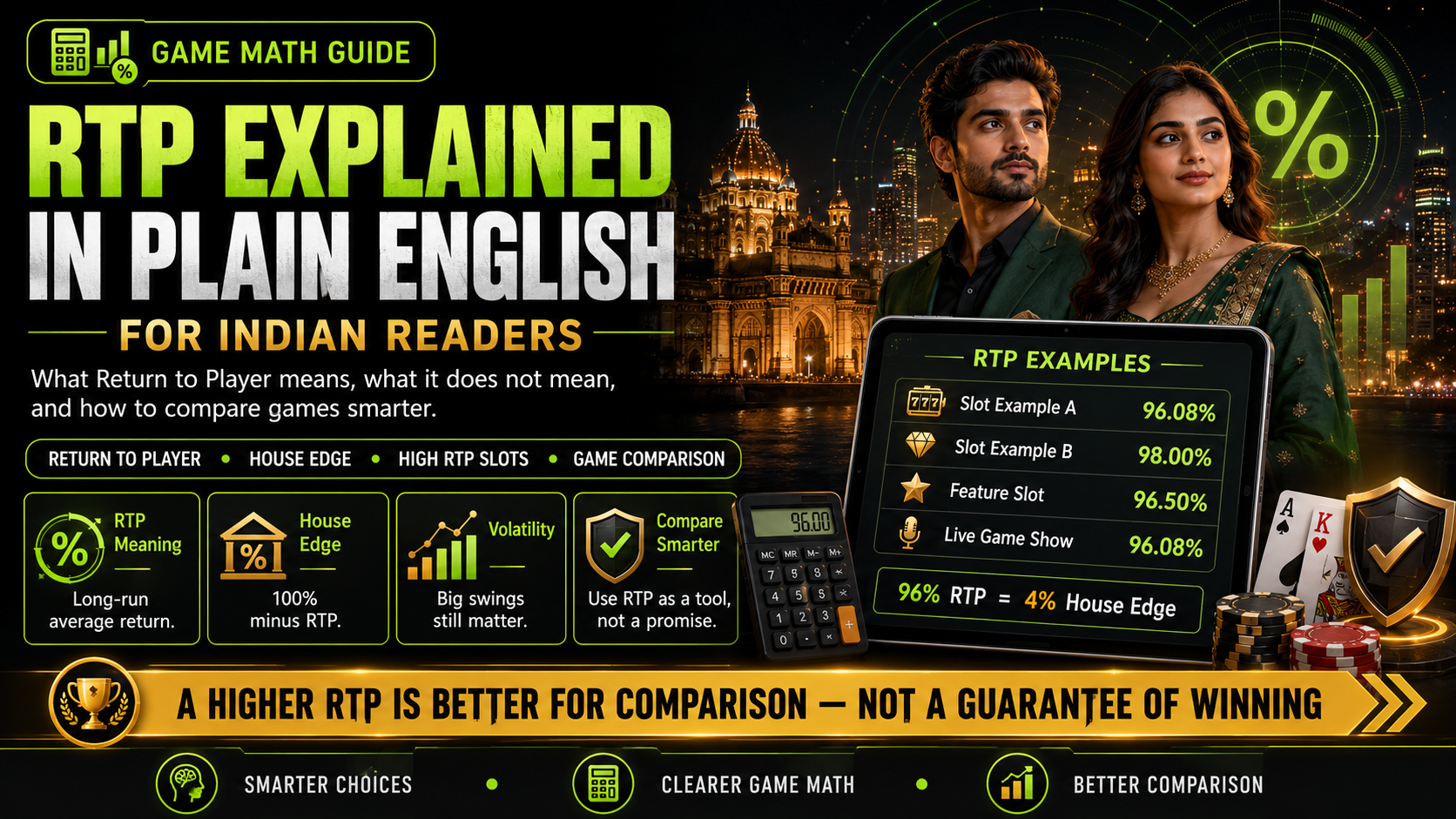
RTP stands for Return to Player. It is the long-run percentage of wagered money that a game is designed to pay back over a very large number of rounds. The most important thing to remember is what RTP does not mean: it is not a short-term promise, not a session forecast, and not a strategy.
RTP and House Edge
If a slot has 96% RTP, the built-in operator advantage is 4%. That advantage is called the house edge. Higher RTP usually means a lower long-run house edge, but it does not make a game safe, predictable or profitable.
- 95% RTP means a 5% house edge.
- 96% RTP means a 4% house edge.
- 98% RTP means a 2% house edge.
Why RTP Does Not Predict Your Next Session
A 96% RTP game does not mean your next 1000 rupees will return 960. Short-term results are driven by variance. One player may lose quickly, another may hit a bonus early, and both experiences can still fit the same theoretical RTP.
RTP vs Volatility
RTP measures long-run return. Volatility describes how wins and losses are distributed. Two games can have similar RTP and feel completely different: one may pay smaller wins more often, another may stay quiet and then deliver larger swings.
What Else Readers Should Compare
- Hit frequency.
- Bonus features and maximum win.
- Table rules or game-show mechanics.
- Published RTP inside the actual game version.
- Whether different RTP versions exist for the same title.
Common RTP Myths
RTP does not mean a slot is “due.” It does not become more likely to pay because it was cold earlier. Bonus features do not beat RTP because they are already part of the model. High RTP also does not guarantee profit.
Responsible Reading of RTP
For Indian readers, RTP is best treated as educational knowledge. It helps compare games, but it does not remove legal risk, financial risk, or the randomness built into chance-based play.
FAQ
1. What does RTP mean?
It means Return to Player, the theoretical long-term percentage a game returns over many rounds.
2. Is RTP the same as volatility?
No. RTP measures return, while volatility describes how swing-heavy the experience feels.
3. Does RTP guarantee winnings?
No. It is not a personal payout promise.
4. Can the same game have different RTP versions?
Yes. That is why readers should check the actual game information screen.
5. Should RTP be used as a strategy?
No. It is a comparison tool, not a prediction tool.